Wind Orchestra Program
November 15, 2026
Fanfare and Flight
Symphony in Bb
Moderately fast, with vigor
Andantino grazioso; Fast and Gay
Fugue: Rather broad
Momentum
Guest Conductor, Jeanne Christensen
Horror Vacui
Suite from The Dark Crystal
World Premiere
Combined Mission Hills and FCWO Bands
Noah Hudson-Camack
(b. 2001)
Paul Hindemith
(1895-1963)
Thomas Doss
(b. 1966)
Andrew David Perkins
(b. 1978)
Trevor Jones
(b. 1949)
Arr. Aaron Mulder
Program Notes
Welcome to the Finest City Wind Orchestra’s portion of the program, Dark Winds. October is over… November is the month where the warm Santa Ana afternoons and Spirit Halloweens give way to the early dusks ushered in by brisk chills in the air. It’s a perfect time for a concert anchored by a cavernous and cacophonous warhorse of the repertoire, next to pieces screaming homage to classic horror-fantasy films.
About our Guest Conductor
Jeanne Christensen retired in May 2025 after a distinguished 34-year career teaching high school instrumental music and 36 years of service to band education. Most recently, she served as Director of Bands at Mira Mesa High School in San Diego Unified School District, where she built the district’s largest band program and one of Southern California’s largest.
A San Diego native and University of San Diego graduate, Jeanne also holds a master’s degree in Educational Leadership from National University. She currently serves as President of the California Band Directors Association and has held numerous leadership positions in state and regional music education organizations.
A sought-after guest conductor and clinician, Jeanne has led honor ensembles and student performers at prestigious venues and events worldwide, including Carnegie Hall, the Kennedy Center, the Sydney 2000 Olympic Games, and the Tournament of Roses Parade. Her many honors include the 2022 NFHS Outstanding Music Educator Award for California and the John Philip Sousa Legion of Honor Award.
Her career is guided by two principles: All In and Make a Difference.
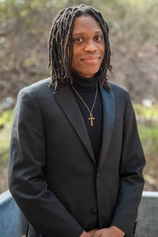
Noah Hudson-Camack was born in 2001 in North Carolina. He began composing Volo Volare shortly after graduating from high school in 2020, at a time when a career in music seemed anything but certain. The title refers to the two meanings of the Latin verb volo: “to want” and “to fly.” Later, while attending Vanderbilt University, Hudson-Camack was approached by Director of Bands Tom Verrier, who wanted to program Volo Volare for an upcoming conference performance but didn't have time for the full eight-minute work. The result was a flashy, condensed opener focusing exclusively on the “flight” idea from the larger composition: the Fanfare and Flight opener you will hear today. Listen for the distinctive four-note motif introduced immediately by the trumpets and recurring throughout the piece. The same motif can be heard prominently in the longer work at 1:25, played by the bassoon, with variations appearing throughout.
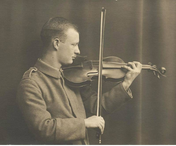
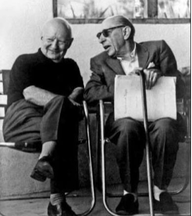
Paul Hindemith and his musical style are sandwiched between those of some more famous contemporaries. Born in the late 19th century, he overlapped with the lush harmonies and grand orchestrations of post-Romantics such as Gustav Mahler. By the middle of the 20th century, during his formative years as a composer, he also encountered the Second Viennese School, whose members were abandoning traditional tonality and structure, including Arnold Schoenberg and Alban Berg. Hindemith knew these styles well but never fully embraced either. His approach more closely aligned with that of Igor Stravinsky, who incorporated some of Schoenberg’s dissonance while retaining Classical, Mozartian structures, often tinged with Russian folk charm (or blood). Still, Hindemith’s voice was uniquely his own, making his Symphony in Bb distinctive not only in the wind band repertoire but in the broader symphonic tradition.
Hindemith was born in 1895 outside Frankfurt, Germany. He began studying violin and later viola at an early age. After serving in World War I, he toured Europe as a violist. As he began composing more seriously in the 1930s, his music was frequently banned by the Nazi Party. Combined with his wife’s Jewish ancestry, this led him to emigrate to Switzerland in 1938. He also traveled extensively to the United States during this period, notably as a founding faculty member at Boston’s Tanglewood. He later moved to the U.S. to teach at Yale University, became an American citizen in 1948, and eventually returned to Switzerland for his final years of composing, teaching, and retirement.
In December 1950, Sergeant Keith Wright, a member of the U.S. Army Band, formally invited Hindemith to conduct the ensemble at an upcoming concert. Hindemith agreed, adding that if he could appear at a later concert, “he might just write a little something.” Just four months later, on April 5, 1951, the U.S. Army Band premiered the Symphony in Bb, with Hindemith conducting; you can hear a recording here.
The three-movement symphony is bold and crunchy, yet at times endearing and thoughtful. Hindemith uses intricately constructed melodies to take listeners on an adventure through Classical forms. Movement I, “Moderately fast, with vigor,” follows a traditional sonata-allegro form in many respects. An opening theme in Bb is contrasted with a second theme in the dominant key, following convention for the opening section, or “exposition.” Hindemith then gives us a second exposition, however, which is unusual, and this time he bends the rules for the keys as well. We get two developments, as one might expect, followed by another curveball in the final section, or “recapitulation.” Rather than presenting the original themes again in the home key of Bb, he combines them in counterpoint, simultaneously, in more distant keys (Bb and F#). He then does essentially the same thing in a second recap. He knows the sonata rules but clearly enjoys stretching them!
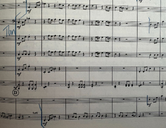
A Classical symphony would traditionally follow with a slower movement, then a quicker movement in triple meter. Hindemith does both, but combines them into a single movement, eventually bringing the two styles together. Listen for the lovely, awkward solos passed between alto saxophone and trumpet, accompanied by a curmudgeonly “harrumph” in the wrong meter. These give way to a contrasting, bubbly scherzo that is sometimes almost ditzy and sometimes downright middle-school mean.
We could talk about fugues all day. Essentially, a fugue takes a single theme and repeats and develops it over and over, fitting it against itself, its variations, and a whole collection of musical rules and techniques. Many fine composers struggled with the form (Beethoven) or barely attempted it (Chopin); arguably, one reason J.S. Bach remains so celebrated is his extraordinary genius for fugue writing. In this third movement, Hindemith introduces an opening fugue subject: an angular, disjunct, ascending melody. Although it is an eight-bar phrase, the next statement enters after just 7½ bars (while still following the harmonic rules, for what it's worth). The next enters only four bars later (oops, breaking those rules), and the following one 4¼ bars after that – Hindemith almost immediately blurs the distinction between the fugue's exposition and development. Then, as if that weren't enough, he introduces an entirely separate SECOND fugue, with a contrasting, legato, conjunct melody, treated just as liberally as the first. In the finale recap, he brings both fugue subjects together along with the opening theme from the first movement. The result is cacophony, but underpinned by an almost mathematical deliberateness that gives the music structure and meaning. For more detail, including musical examples, I recommend you check out our YouTube page and the “Horrible Hindy” video.
Composer Thomas Doss offers a welcome contrast following our symphony. Born in Linz, Austria, he is best known for his wind band compositions, although he has also written for orchestra and chamber ensembles. In addition to studying in Europe, he spent time as an intern at MGM Studios in Los Angeles, working alongside composers including John Williams, undoubtedly influencing his cinematic style. Momentum is a slow piece intended to provide a calm “point of rest” in more fast-paced programs, despite the sometimes forceful connotations of its title. Listen for the especially warm sounds of the flugelhorns, as well as the masterful interpretation brought to the podium by guest conductor Jeanne Christensen.
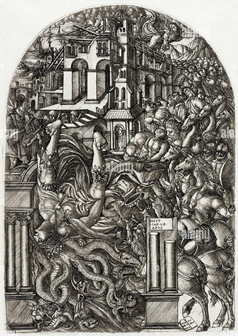
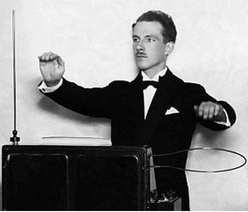
Andrew David Perkins is often drawn toward the cinematic, whether overtly in his most recent War of the Worlds project or score to Hitchcock classic The Birds, stylistically in melodies of Alcatraz or curious sounds of The Raptor Rides the Whale, or more subtly throughout much of his prolific output, especially in his distinct harmonic language and orchestration. Horror Vacui is no exception and may even be his most extreme example (especially in the version you’ll hear today). The Latin title refers to the fear of emptiness, a concept expressed in visual art by filling—or overfilling—an entire space with intricate detail. From its opening notes, the piece explores how a band can deliberately overwhelm an audience with sound, while contrasting this idea with an homage to the horror and sci-fi films of the mid-century modernist period, which often relied on more minimalist approaches to drama. FCWO is thrilled to work with Perkins during rehearsals and bring a new theremin part to life for this performance. Created around 1920 by a Russian physicist, the instrument uses two metal antennas and the movement of the player's hands to control an electromagnetic field and alter pitch and volume. You’ll immediately recognize its sound as synonymous with the impending doom of 1950s flying saucers, as heard in the opening credits of the film The Day the Earth Stood Still.
About the Music Director
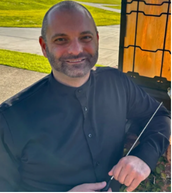
Dr. Jeffrey Malecki grew up in Sterling Heights, Michigan. He holds degrees in music education and conducting from Central Michigan University, VanderCook College, and the University of Nevada, Las Vegas. Dr. Malecki began his career at Sunnyslope High School in Phoenix. He worked closely with mentors John Williamson, Thomas Leslie, Tad Suzuki, and Col. John Bourgeois to broaden his understanding of conducting, teaching, and programming, performing nationally as well as abroad in England, Ireland, Italy, and Peru.
After leading the ensembles and music education program at St. Xavier University in Chicago, Dr. Malecki began the formal band program at the University of San Diego in 2014. The program has grown into the Wind Ensemble, Torero Pep Band, and Drumline. The Wind Ensemble has led several commissions and premieres by composers such as Andrew David Perkins, Donald Grantham, Ingrid Stolzel, and Viet Cuong, in addition to encouraging esprit de corps across campus. Helping found the Finest City Wind Orchestra in 2024, Dr. Malecki looks forward to continuing being a part of San Diego’s vibrant music culture.