Grand Canyon Fanfare
Choose Joy
Black Horse Troop
Southwestern College Concert Band
Dr. Bruce Mansfield, director
James Newton Howard
(b. 1951)
Randall Standridge
(b. 1976)
John Philip Sousa
(1854-1932)
Toccata Marziale
Suite from Umbrellas of Cherbourg
Soulström
Duende
Allegro giusto
Animato
Cadenza a piacere, molto sentito - lento evocativo
Tempo di bulería
John and Jim
Finest City Wind Orchestra
Dr. Jeff Malecki, director
Ralph Vaughan Williams
(1872-1958)
Michel Legrand
(1932-2019)
arr. Øivind Westbye
Jodie Blackshaw
(b. 1971)
Luis Serrano Alarcón
(b. 1972)
Viet Cuong
(b. 1990)
Ralph Vaughan Williams was one of the most notable composers to come out of England, along with his good friend and contemporary Gustav Holst. Both composers wrote extensively for symphony orchestra in the late 19th and early 20th century, but also made their mark writing some of the first major original works for military band, now known more as concert band. Vaughan Williams wrote his most famous piece for band, his English Folk Song Suite, in 1923, a relatively simple and lovely setting of several folk songs over three movements. His Toccata Marziale was written the next year in 1924, but was quite the opposite in style. We start with the title itself: “Toccata” comes from the word “touched,” as in touching a keyboard in particular. It references a free, often virtuosic form common in solo organ or harpsichord repertoire from as early as the Baroque period. “Marziale,” however, references a march style, referencing a more stringent and disciplined approach to rhythm in particular. So which is it??
Vaughan Williams tends to trick us a bit here! While the second theme gives way to a lovely folk-like melody evocative of something we’d hear in the Folk Song Suite, a significant majority of the phrases of the piece jump and shift between simple and compound meters, 2, 3, 4, 5, 6 and 7s, sometimes juxtaposed on top of each other not quite lined up. Try listening and tapping your foot, here or at home to a fine studio recording like this one by the U.S. Marine Band, “The President’s Own,” and you’ll find it’s tricky to anticipate quite where the beat is coming or going. But then, try watching a conductor, like on stage today or this one on mute with Dr. Michael Haithcock and the Michigan band. You’ll notice the conductor’s job is painfully easy – Vaughan Williams keeps the piece in ¾ time throughout, despite the feel of complex rhythmic shifts. This is due at least in part to Lieutenant H.E. Adkins, who conducted the massed band premiere at an outdoor soccer tournament and preferred a large “floor-wall-ceiling style of music in 3,” common for the time.
Umbrellas of Cherbourg was released in 1964, originally in France and later that year in the United States. It tells the story of Genevieve and Guy, two young lovers whose relationship is disrupted when Guy is drafted into the Algerian War. Regardless of their turmoil, dialogue is completely sung throughout the film to a brilliant score by the composer Michel Legrand. Most of the flirtatious melodies in our medley includes lively swing and bossa nova. “I Will Wait For You,” the film’s signature melancholy ballad, has become a standard in the American songbook, and has been recorded by Louis Armstrong, Frank Sinatra, Gil Evans, Lena Horne, Liza Minnelli, and Jessye Norman.
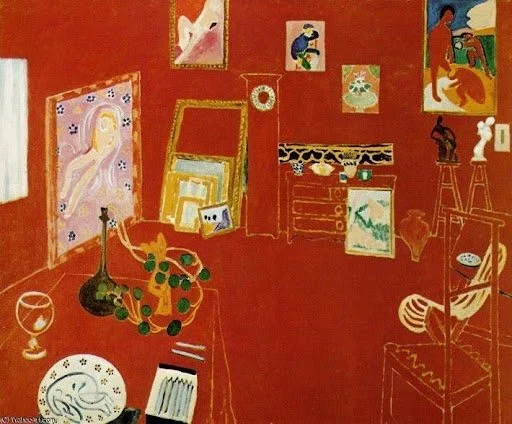
Director Jacques Demy famously used a visual aesthetic inspired by the French painter Henri Matisse, known for his brilliant and bold use of color. In some of the opening scenes inside the umbrella shop, notice striking pink walls and colorful umbrellas which arguably overtake the characters despite their bright red tops. In Matisse’s painting The Red Studio, the bright Venetian red also overtakes the painting, with the objects seeming almost secondary and scattered, the table and chair even becoming transparent.
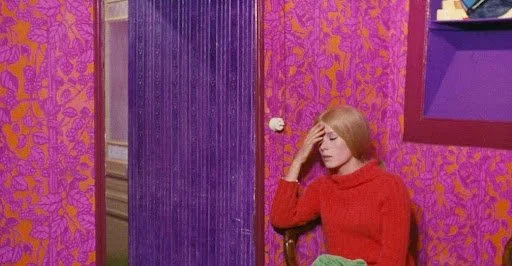
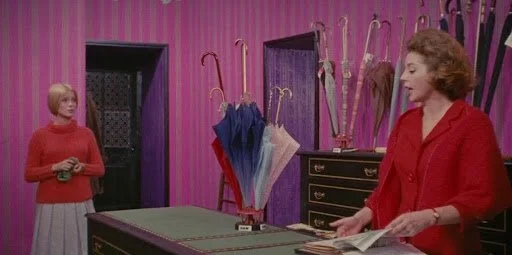
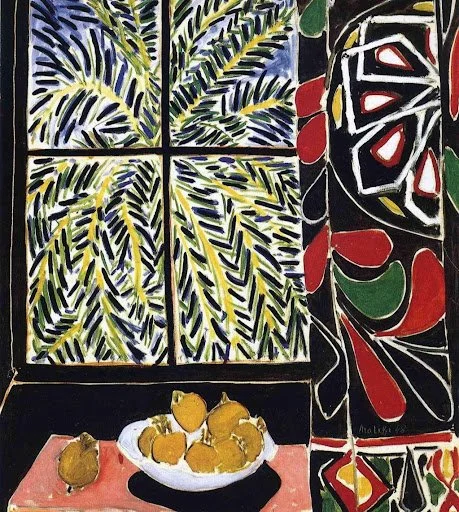
Demy also appreciated Matisse’s use of contrasting and even clashing patterns. The variations of pink in the striped wallpaper from the umbrella shop above may be one example, but for an even better example we see a distraught Genevieve in front of an already-busier pink/pink orange wallpaper, next to a contrasted textured purple door and wearing her differently textured red sweater. Compared to Matisse’s painting Interior with an Egyptian Curtain, we can see more of the contrasts in action!
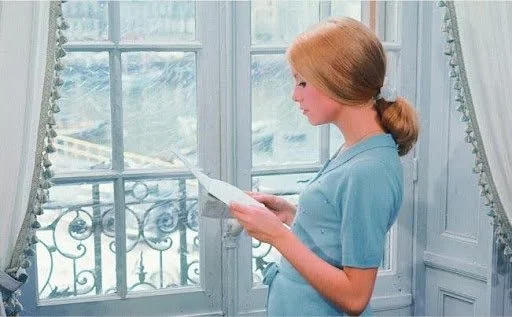
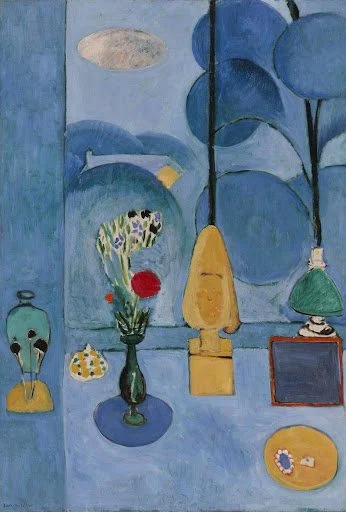
Finally, Demy takes some inspiration from Matisse and uses it to accentuate his own nuances in the story. Matisse’s The Blue Window uses a primarily monotone blue palette, with gold as a secondary color. Demy uses the same monotone technique to evoke the painting; blues for both the interior and exterior, with Genevieve’s blond hair referencing the gold. While Matisse was inspired by a neutral, loving morning with his wife, Demy changes the meaning and leans into blue as a signal for sadness, as Genevieve reads a letter hopeful for good news from her war hero-lover Guy (regretfully, I think this one is just the electric bill).